
Every IT decision, acquisition or renewal, made before negotiation. And each decision makes the next one sharper.






In ten years, IT contracts per company have tripled. Recurring models force a renewal every two to three years. Meanwhile, procurement tools have not moved.
Result: 80% of contracts are renewed by default. Lack of time, lack of market visibility, requestor bias. The decision is locked before it is even asked.
Three recent shifts have changed the equation. More credible alternatives than ever. Transition costs divided by AI. Near zero cost market monitoring. Re-asking the question at every renewal is finally scalable.
Your IT contracts loaded from Excel or ERP export. The portfolio builds in minutes.
Credible alternatives, exit costs, technical dependencies, usage signals. The economic lever surfaces, contract by contract.
For each line, a decision among RETAIN, REPLACE, STOP. Auditable reasoning, net transition ROI computed.
When a decision hits missing data, OnSource points to exactly what's needed to call it.
New acquisitions join the portfolio. Continuous market re-scoring, renewal alerting.
A structured decision. Six possible outcomes.
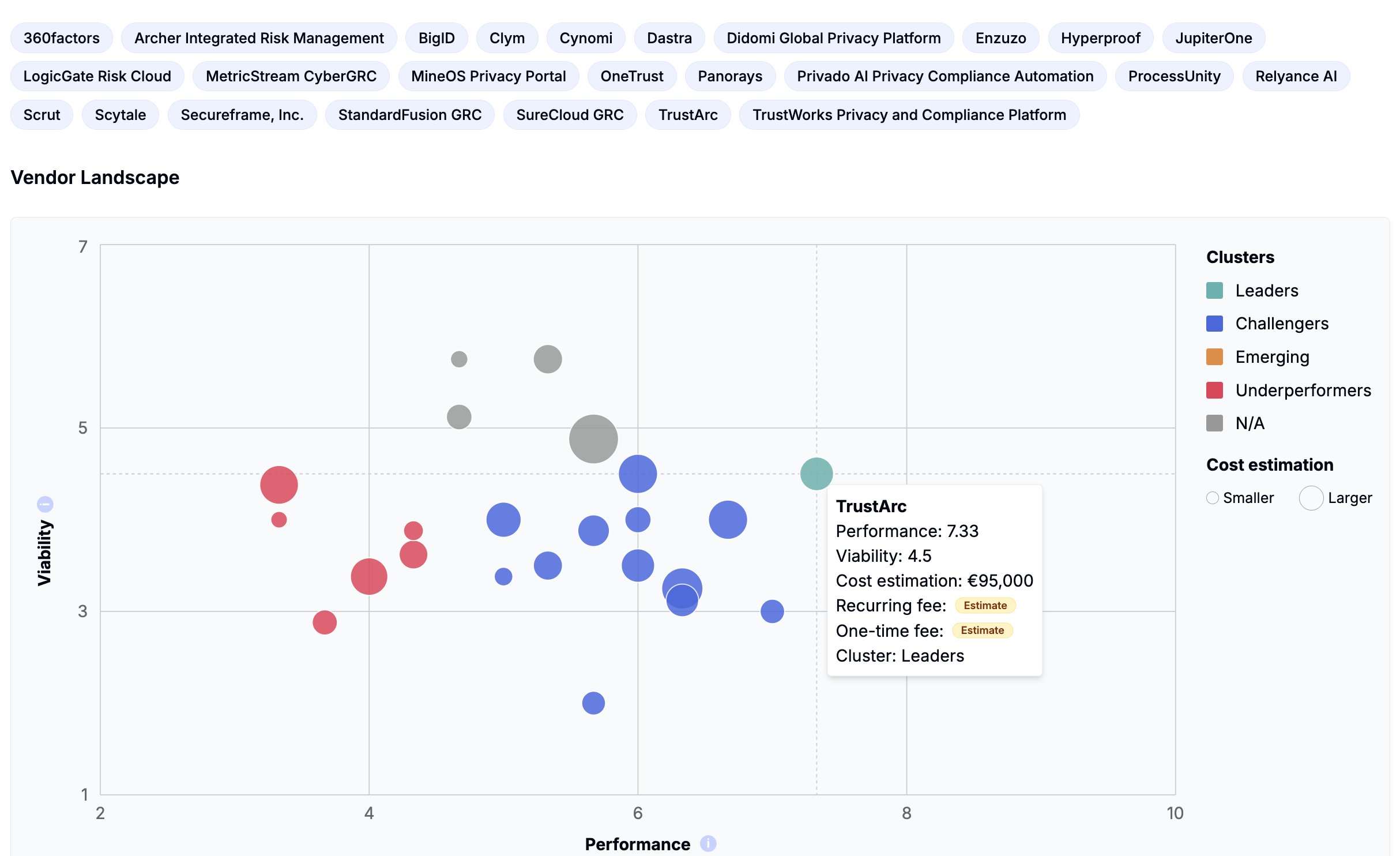
For every IT contract or need, a reasoned recommendation among six possible decisions. OnSource maps the technical dependencies, computes the true exit cost, and surfaces the economic leverage before any negotiation.
Your IT portfolio under continuous control.
A governed view of all your IT contracts. Continuous market re-scoring, vendor overlap detection, deadline alerting. Brief memory activates retroactively when the Portfolio opens.
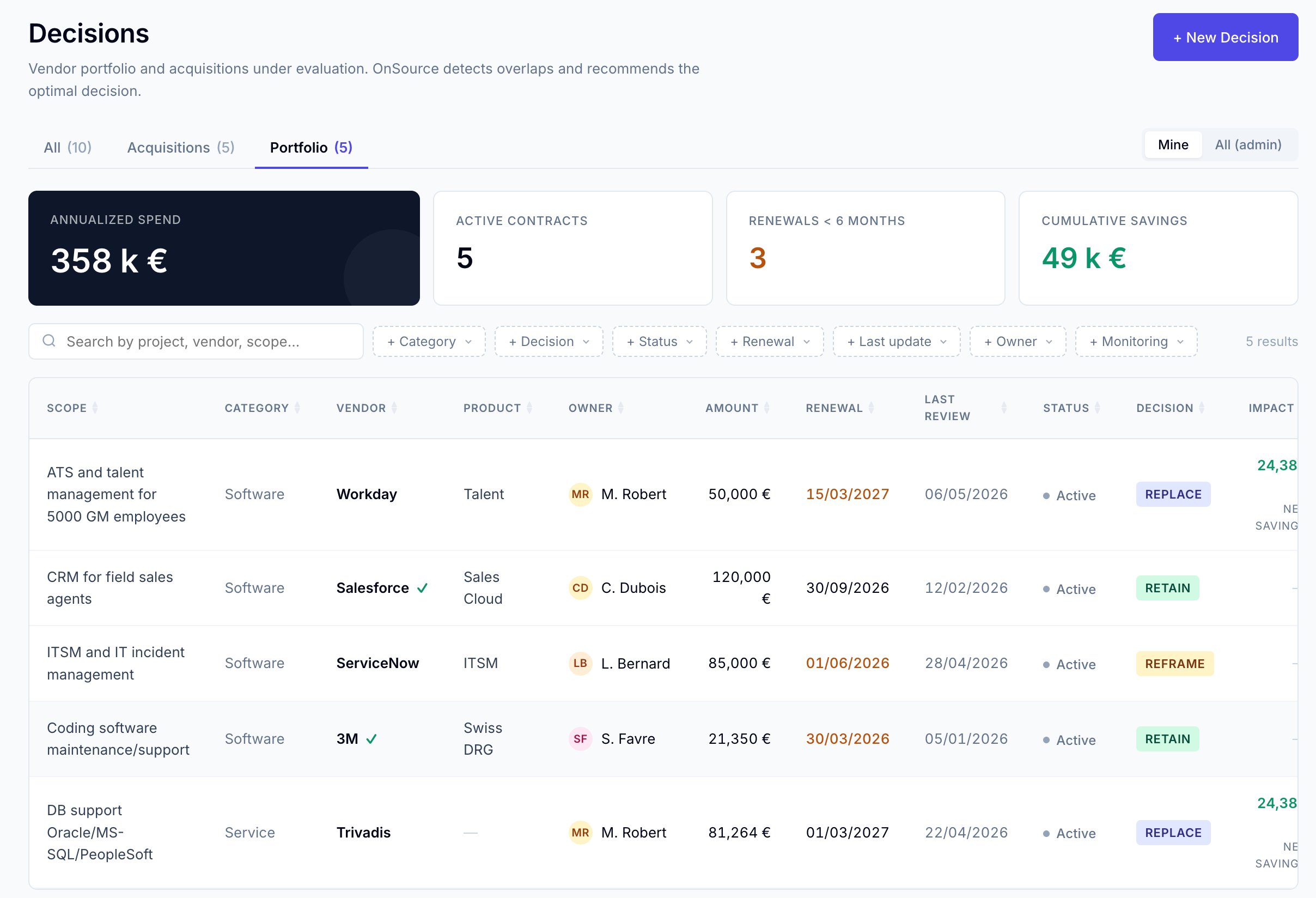
Every decision is traced: context, alternatives evaluated, net transition ROI, argued recommendation.
Every Brief automatically feeds your organization's memory. Vendors seen, arbitrations, retained signals.
Continuous re-scoring and overlap detection across the portfolio. Decisions inform one another.
Credible alternatives surface upstream. The lever becomes a number, no longer an argument.
Beforea few percent shaved off in final renegotiation.
Search, comparison, validation. What used to take a quarter, delivered in one analysis.
Beforea full sourcing cycle for every critical contract.
Every IT contract tracked continuously, not just the top twenty. Blind spots disappear.
Before20% monitored, the rest renewed by default.
Three layers in the IT sourcing chain. Gartner informs. OnSource decides. Ariba executes. The missing middle layer is what produces the 80% renewed by default.
Gartner provides information. OnSource provides the decision. Ariba handles the transaction.
Les SaaS Management Platforms (Vertice, Najar, Tropic) se concentrent sur le SaaS, la négociation de prix et les renouvellements. Elles interviennent après que l'arbitrage fournisseur est fait. OnSource intervient avant : nous couvrons tous les segments IT (logiciels, services, télécom, hardware) et déterminons si un contrat doit être challengé, remplacé ou résilié. Si la décision initiale est mauvaise, optimiser le prix ne sert à rien.
Decision Brief est conçu pour les décisions ponctuelles. Vous testez sur un sourcing ou un renouvellement critique, vous obtenez une recommandation structurée et versionnée. Portfolio Hub est conçu pour gouverner un portefeuille IT en continu : re-scoring permanent, détection des recoupements, alerting sur les échéances. La plupart de nos clients commencent par un Brief, puis passent au Portfolio quand la valeur de la mémoire cumulative devient évidente.
OnSource ne recommande jamais une alternative sans calculer le ROI net de transition. Les coûts réels d'intégration, de formation et de sécurité sont intégrés. Si les gains ne couvrent pas le coût du changement, la recommandation est de rester.
Un Decision Brief produit une recommandation prête à décider en quelques minutes. Vous pouvez tester dès aujourd'hui sur un contrat de votre choix. Pour le Portfolio Hub, l'onboarding du portefeuille prend quelques jours et les premières alertes arrivent dès que les contrats sont chargés.
Au minimum : vos contrats IT (fournisseur, montant, date de renouvellement). OnSource enrichit ensuite avec des données de marché, des benchmarks de prix et des signaux d'usage pour produire des recommandations qualifiées.
Find out which contracts deserve a real fight, before the next negotiation.